

Article
Johannesburg Time Difference: New York, London, Sydney & Dubai
9 November 2026
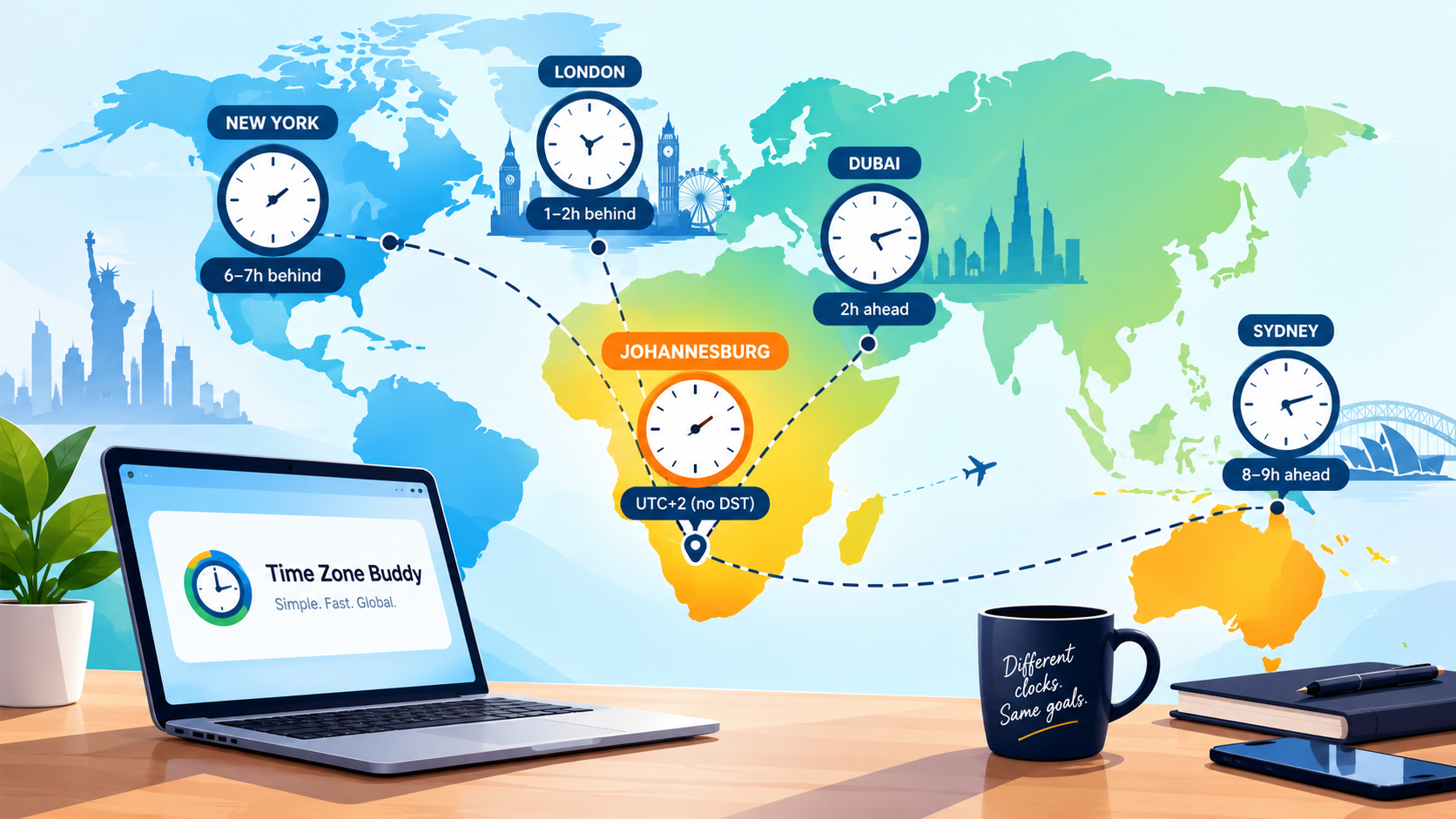
Time Zones Are Confusing. Johannesburg Makes It Interesting.
Why your 3 PM meeting in South Africa keeps changing time overseas — and how Time Zone Buddy can save you the headache.
It's Monday morning in Johannesburg. You've got your coffee, your inbox is overflowing, and you're about to jump onto a video call with a client in New York.
You've done this before. Same client. Same time. Same routine.
Except today, your client is an hour late.
Or are you an hour early?
Welcome to the wonderful, slightly ridiculous world of international time zones.
Here's the funny thing: South Africa hasn't changed its clocks at all. We don't do daylight saving time. Our clocks stay exactly where they are, all year round.
But much of the rest of the world? They're busy moving time forward and backward like it's furniture.
And if you work with people overseas, that can make scheduling surprisingly tricky.
South Africa: The country that leaves its clocks alone
Johannesburg runs on South African Standard Time (SAST), which is UTC+2.
- January? UTC+2.
- July? Still UTC+2.
- Christmas morning? You guessed it. UTC+2.
No changing clocks. No losing an hour of sleep. No wondering whether the microwave clock is correct.
Unfortunately, our international friends don't all share this sensible arrangement.
Here's how Johannesburg compares with four popular international business destinations:
| City | Time difference |
|---|---|
| 🇺🇸 New York | 6 or 7 hours behind |
| 🇬🇧 London | 1 or 2 hours behind |
| 🇦🇺 Sydney | 8 or 9 hours ahead |
| 🇦🇪 Dubai | Always 2 hours ahead |
Notice something? Three of those cities have two possible answers.
That's daylight saving time doing its thing.
So why does the time difference keep changing?
Daylight saving time was introduced in various countries to make better use of daylight during the warmer months.
The idea sounds simple enough: move clocks forward by an hour in spring and backward again in autumn.
The problem is that countries don't agree on when to do it.
The United States and United Kingdom change clocks on different dates. Australia follows its own schedule, with summer occurring at the opposite time of year from the Northern Hemisphere.
South Africa simply watches all this clock-changing from the sidelines.
And that's why a recurring international meeting can suddenly shift by an hour, even though nobody deliberately rescheduled it.
Meet Time Zone Buddy: Less calculating, more doing
Time Zone Buddy
A browser extension by Raymarc Interactive
Nobody wants to stop what they're doing to calculate whether it's a reasonable hour to call someone halfway around the world.
That's the idea behind Time Zone Buddy, designed to make checking international time differences easier.
Whether you're juggling overseas clients, working with a remote team, or simply trying not to wake somebody up at 3 AM, having a convenient time zone companion makes life simpler.
Because your brain has better things to do than calculate UTC offsets.
A few tricks to avoid international meeting disasters
Before sending that next calendar invitation, remember three simple things.
Always include the time zone. Saying "Let's meet at 2 PM" is asking for trouble. "14:00 SAST" leaves much less room for confusion.
Watch out for March and October. These are particularly interesting months because several countries change their clocks around this period. The United States also switches back in November, and Sydney's seasonal changes occur in April and October.
Check the actual date, not just the usual difference. What worked last month might not work today. A date-aware converter can save you an embarrassing missed call.
Time is precious. Don't waste it figuring out what time it is.
The world is more connected than ever. We collaborate across continents, work with international clients, and jump between virtual meetings without giving geography much thought.
But clocks? They still haven't learned to cooperate.
Fortunately, you don't need to become a time zone expert to work internationally.
A little awareness, a reliable time converter, and a handy tool like Time Zone Buddy can help keep everyone on the same page — and in the same meeting.
Now, about that New York client who's an hour late...
Maybe check the clock before sending that follow-up email.